Power Allocation and Transmission Mode Selection in Uplink D-MIMO ISAC Systems

Authors

DOI:

https://doi.org/10.14209/jcis.2026.18

Keywords:

integrated sensing and communication, transmission mode selection, distributed MIMO

Abstract

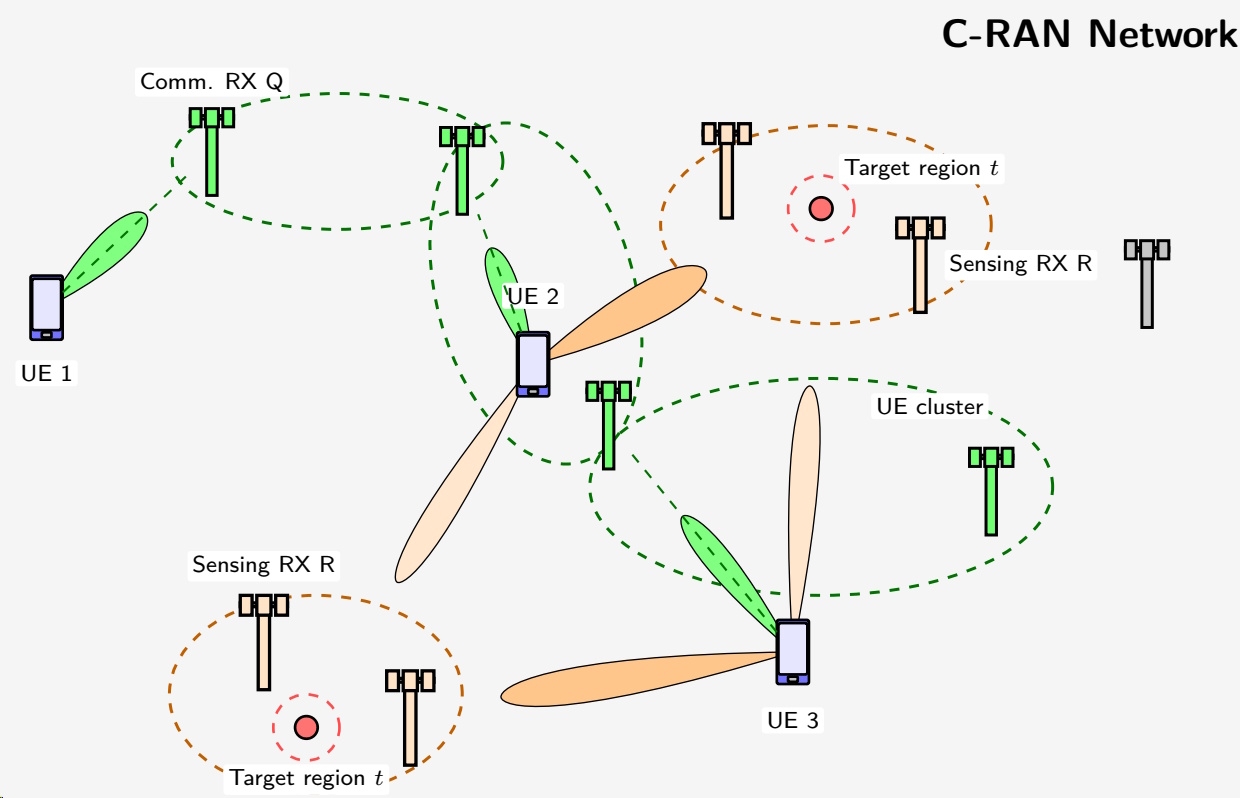
Most integrated sensing and communication studies focus on downlink sensing, where base stations transmit sensing signals. In contrast, this work considers an uplink sensing scenario in a user-centric distributed multiple-input multiple-output centralized cloud radio access network, where users may simultaneously transmit sensing and communication signals. An integer optimization problem for transmission mode selection assigns each user to transmit only a communication signal or both communication and sensing signals with the goal of maximizing the communication sum-rate while satisfying minimum mainlobe-to-average-sidelobe-ratio constraints. This problem is solved via branch-and-bound and using heuristics based on the k-nearest neighbors and large-scale fading with equal and fractional power allocation. The numerical results show that optimal selection establishes an upper bound for sum-rate performance, whereas heuristics prioritize sensing performance at ≈ 22% sum-rate cost, evidencing the need for joint power allocation and user selection.

Downloads
Download data is not yet available.

Author Biographies

Ezequias M. S. de Santana Jr., Wireless Telecommunications Research Group, Federal University of Ceará

Received the B.Sc degree in telecommunications engineering and the M.Sc. in teleinformatics engineering from the Federal University of Ceará (UFC), Fortaleza, Brazil, in 2020 and 2022, respectively, where he is currently pursuing the Ph.D. degree in teleinformatics with focus on systems and communications networks. Since 2020, he has been a Researcher with the Wireless Telecommunications Research Group (GTEL), UFC, Brazil, working in research projects within a technical and scientific cooperation with Ericsson Research, Sweden. In 2023-24, he was visiting Ericsson as a gest researcher in Luleå, Sweden, for a six month period. His research interests include optimization and machine learning for wireless communication systems, MIMO communications, simulation of cellular communication systems, channel parametrization and 5G/6G networks.

Pedro Victor M. Castro, Wireless Telecom Research Group (GTEL)

Possui bacharelado em Engenharia Elétrica pela Universidade Federal do Ceará (Sobral). Durante a graduação foi monitor do Programa de Iniciação à Docência (PID) e foi bolsista PIBIC/IC, PIBIC/ICT Funcap e PIBIC/CNPQ onde participou da pesquisa intitulada "Transferência de energia sem fio associada a tecnologias emergentes como NOMA e Full-Duplex" que resultou no TCC com o título "Formatação de feixes para redes de comunicações energizadas por meio sem fio". Atualmente é afiliado ao Grupo de Pesquisa em Telecomunicações sem Fio (GTEL). Além disso, tem interesse em Integrated Sensing and Communication (ISAC) com enfoque em problemas de otimização, estimação de parâmetros e detecção de sinais.

Yuri C. B. Silva, Wireless Telecom Research Group (GTEL)

Yuri C. B. Silva received the B.Sc. and M.Sc. degrees in electrical engineering from the Federal University of Ceará, Fortaleza, Brazil, in 2002 and 2004, respectively, and the Dr.-Ing. degree in electrical engineering from the Technische Universität Darmstadt, Darmstadt, Germany, in 2008. From 2001 to 2004 he was with the Wireless Telecom Research Group (GTEL), Fortaleza, Brazil. In 2003 he was a Visiting Researcher at Ericsson Research, Stockholm, Sweden. From 2005 to 2008, he was with the Communications Engineering Laboratory of the Technische Universität Darmstadt. He is currently an Associate Professor with the Federal University of Ceará and Researcher at GTEL. He also holds a productivity fellowship in technological development and innovation from CNPq. His main research interests include wireless communications systems, multi-antenna processing, interference management, multicast services, and cooperative communications.

Roberto P. Antonioli, Wireless Telecom Research Group (GTEL)

Roberto Pinto Antonioli received the B.Sc. degree in teleinformatics engineering (magna cum laude) from the Federal University of Ceará (UFC), Fortaleza, Brazil, in 2016, and the M.Sc. and Ph.D. degrees in teleinformatics engineering also from UFC in 2017 and 2020, respectively. He currently holds a Post-doc. position with the Wireless Telecom Research Group (GTEL), UFC, where he works on projects in technical and scientific cooperation with Ericsson Research. He is also a Software Developer with Instituto Atlântico, Fortaleza, Brazil. In 2018/2019, he was a Visiting Researcher with Ericsson Research, Sweden. His research interests include 5G wireless communication networks with multiple radio access technologies and multi-connectivity, and also scheduling algorithms for QoS provision.

Walter C. Freitas Jr., Wireless Telecom Research Group (GTEL

Walter C. Freitas Jr. received the B.S. and M.S. degrees in electrical engineering from the Federal University of Ceará, Fortaleza, Brazil, and the Ph.D. degree in teleinformatic engineering from the Federal University of Ceará, in 2006. During his studies, he was supported by the Brazilian Agency FUNCAP and Ericsson. During Q3 of 2015 up to Q2 of 2016, he was a Postdoc Researcher with I3S/CNRS Laboratory, from the University of Nice, Sophia Antipolis, France. During 2005 Walter Freitas Jr. was a Senior Research of the Nokia Technology Institute, He is currently an Assistant Professor with the Department of Teleinformatics Engineering of the Federal University of Ceará and Researcher of Wireless Telecom Research Group one of the most important research groups in telecommunication in Brazil. His main research interests include features development to improve the performance of the wireless communication systems, interference avoidance tools, multilinear algebra, and tensor-based signal processing applied to communications.

G´abor Fodor, Ericsson Research, KTH Royal Institute of Technology

Gábor Fodor (IEEE Fellow ‘25) received the Ph.D. degree in electrical engineering from the Budapest University of Technology and Economics in 1998 and the D.Sc. degree from the Hungarian Academy of Sciences (Doctor of MTA) in 2019. He is currently a Master Researcher at Ericsson Research and a Docent and an Adjunct Professor at the KTH Royal Institute of Technology, Stockholm, Sweden. He has authored or coauthored more than 100 refereed journal articles and conference papers and seven book chapters and holds more than 200 European and U.S. granted patents. He was a co-recipient of the IEEE Communications Society Stephen O. Rice Prize in 2018 He served as Editor for IEEE TRANSACTIONS ON WIRELESS COMMUNICATIONS between 2017 and 2022. He is currently serving as an Associate Editor-in-Chief for IEEE COMMUNICATIONS MAGAZINE and Editor for IEEE WIRELESS COMMUNICATIONS.

Downloads

Published

2026-11-16

How to Cite

Júnior, E. M. S. de S., Pedro Victor Martins Castro, Yuri Carvalho Barbosa Silva, Roberto Pinto Antonioli, Walter C. Freitas Jr., & G´abor Fodor. (2026). Power Allocation and Transmission Mode Selection in Uplink D-MIMO ISAC Systems. Journal of Communication and Information Systems, 41(1), 187–192. https://doi.org/10.14209/jcis.2026.18

Issue

Section

Letters
Received 2026-04-24
Accepted 2026-11-11
Published 2026-11-16