Structure-Informed Estimation for Pilot-Limited MIMO Channels via Tensor Decomposition
DOI:
https://doi.org/10.14209/jcis.2026.15Keywords:
MIMO channel estimation, tensor decomposition, structure-informed learning, low-rank recovery, pilot overhead reductionAbstract
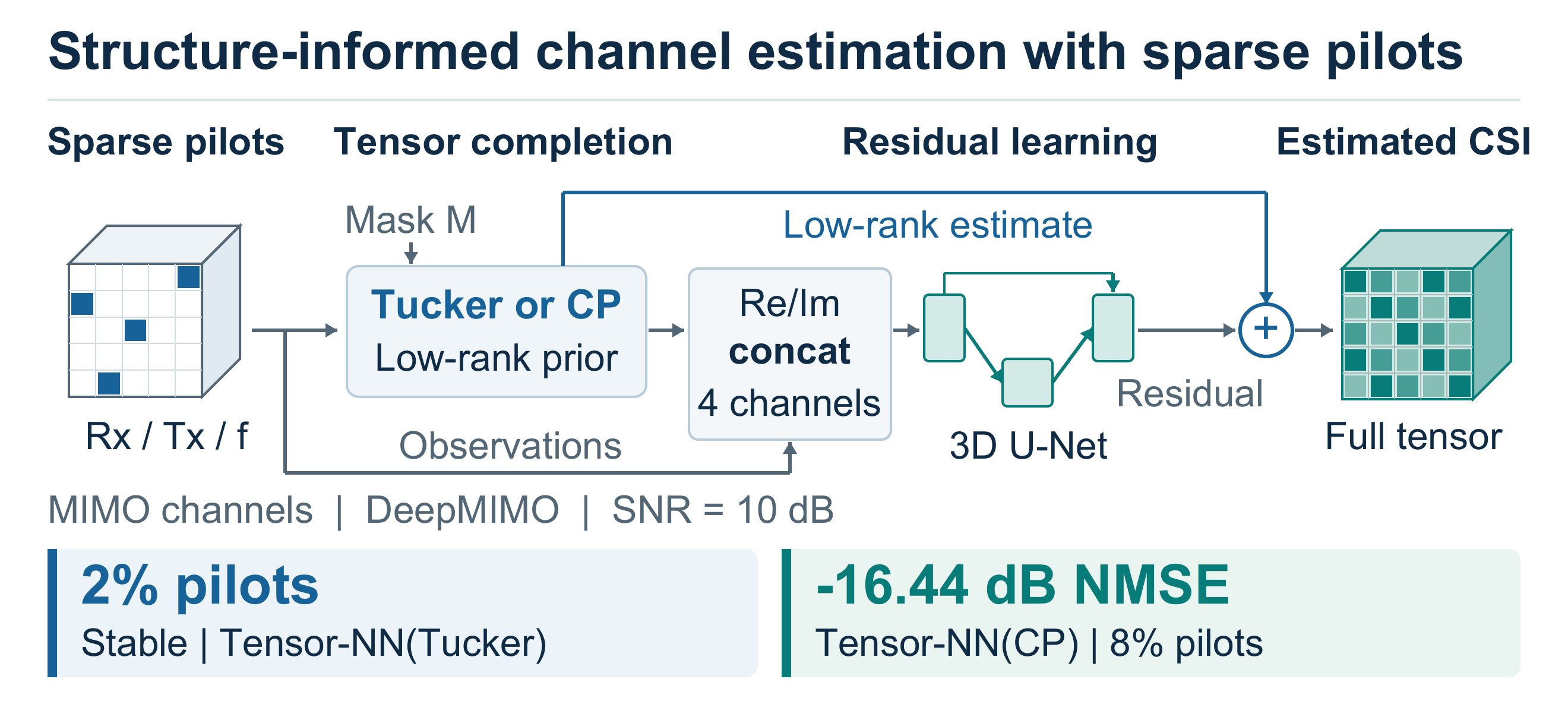
Accurate channel state information in wideband multiple-input multiple-output (MIMO) systems is fundamentally constrained by pilot overhead, a challenge that intensifies as antenna counts and bandwidths scale toward 6G. This paper proposes a structure-informed hybrid estimator that formulates pilot-limited MIMO channel estimation as low-rank tensor completion from sparse pilot observations—a severely underdetermined inverse problem that prior tensor approaches avoid by assuming fully observed received signal tensors. Canonical polyadic (CP) and Tucker decompositions are comparatively analyzed: CP excels for specular channels whose rank-one multipath structure matches the CP parameterization exactly, while Tucker provides greater numerical stability at extreme pilot scarcity where CP exhibits heavy-tail divergence. A lightweight 3D U-Net learns residual components beyond the dominant low-rank structure, compensating for diffuse scattering and hardware non-idealities that algebraic priors alone cannot capture. On synthetic specular channels, Tucker completion achieves 10.88 dB NMSE improvement over least squares and 7.83 dB over orthogonal matching pursuit at ρ = 10% pilot density; CP outperforms Tucker by 13.11 dB at SNR=20 dB under the specular multipath model. On DeepMIMO ray-tracing channels, the hybrid estimator surpasses CP by 2.26 dB and Tucker by 4.80 dB at ρ = 8%, while remaining stable at ρ = 2% where CP diverges; algebraic structure consistently outperforms unconstrained deep learning across the full pilot-density range, with a margin growing from 1.53 dB at ρ = 2% to 5.67 dB at ρ = 20%. Empirical recovery threshold analysis confirms that sample complexity scales with intrinsic channel dimensionality—governed by the number of dominant propagation paths—rather than with the ambient tensor size.
Downloads
Downloads
Published
How to Cite
Issue
Section
License
Copyright (c) 2026 Alexandre Lima (Author)

This work is licensed under a Creative Commons Attribution-NonCommercial 4.0 International License.
Authors who publish in this journal agree to the following terms:
- Authors retain copyright and grant the journal right of first publication with the work simultaneously licensed under a CC BY-NC 4.0 (Attribution-NonCommercial 4.0 International) that allows others to share the work with an acknowledgment of the work's authorship and initial publication in this journal.
- Authors can enter into separate, additional contractual arrangements for the non-exclusive distribution of the journal's published version of the work (e.g., post it to an institutional repository or publish it in a book), with an acknowledgment of its initial publication in this journal.
- Authors are permitted and encouraged to post their work online (e.g., in institutional repositories or on their website) before and during the submission process, as it can lead to productive exchanges, as well as earlier and greater citation of published work (See The Effect of Open Access).
___________
Accepted 2026-08-18
Published 2026-09-10