Probability Distribution Characterization of Link Parameters in LEO Constellations over Brazil
DOI:
https://doi.org/10.14209/jcis.2026.16Keywords:
LEO satellite constellation, satellite communications, probability distribution estimationAbstract
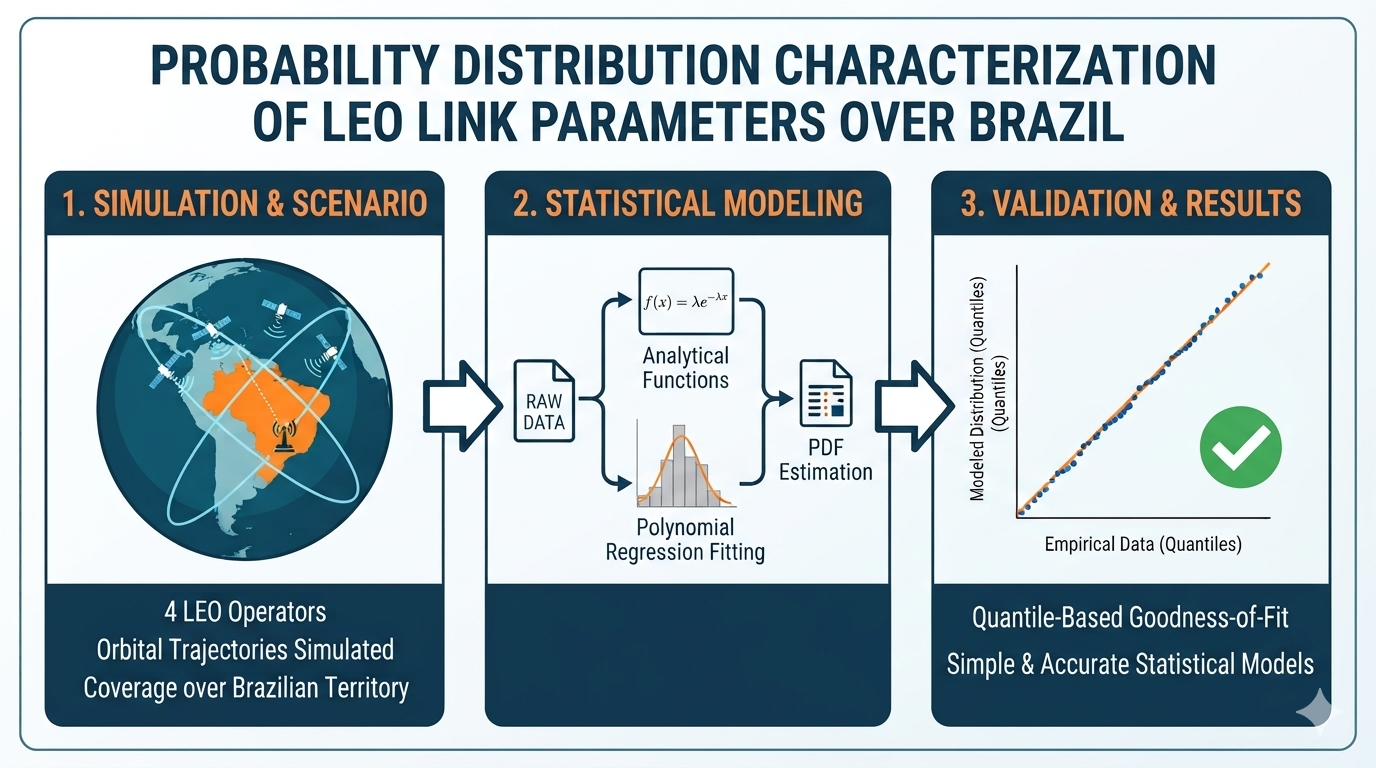
This paper presents a study on the probability distribution of key link parameters in low Earth orbit (LEO) satellite systems, focusing on terminals located in Brazil. A large dataset of satellite orbital trajectories from four different operators is generated through simulation, and the probability density functions (PDF) of relevant link parameters are then estimated using either known analytical functions or by fitting histogram data through polynomial regression. The results presented herein provide simple and accurate statistical models, and a quantile-based goodness-of-fit metric is used to evaluate the agreement between the empirical data and the proposed distributions. Although this type of study has been explored in recent literature, there is still a lack of evaluations specifically addressing coverage across Brazilian territory.
Downloads
Downloads
Published
How to Cite
Issue
Section
License
Copyright (c) 2026 Alberto Gaspar Guimarães, Guilherme da Silva Esteves Ferreira (Author)

This work is licensed under a Creative Commons Attribution-NonCommercial 4.0 International License.
Authors who publish in this journal agree to the following terms:
- Authors retain copyright and grant the journal right of first publication with the work simultaneously licensed under a CC BY-NC 4.0 (Attribution-NonCommercial 4.0 International) that allows others to share the work with an acknowledgment of the work's authorship and initial publication in this journal.
- Authors can enter into separate, additional contractual arrangements for the non-exclusive distribution of the journal's published version of the work (e.g., post it to an institutional repository or publish it in a book), with an acknowledgment of its initial publication in this journal.
- Authors are permitted and encouraged to post their work online (e.g., in institutional repositories or on their website) before and during the submission process, as it can lead to productive exchanges, as well as earlier and greater citation of published work (See The Effect of Open Access).
___________
Accepted 2026-09-01
Published 2026-09-16