Statistical Analysis and Modeling of Material and Frequency Influence on UAV Radar Cross-Section
DOI:
https://doi.org/10.14209/jcis.2026.19Keywords:
Acrylonitrile butadiene styrene (ABS) plastic, log-likelihood, perfect electric conductor, radar cross-section, unmanned aerial vehicleAbstract
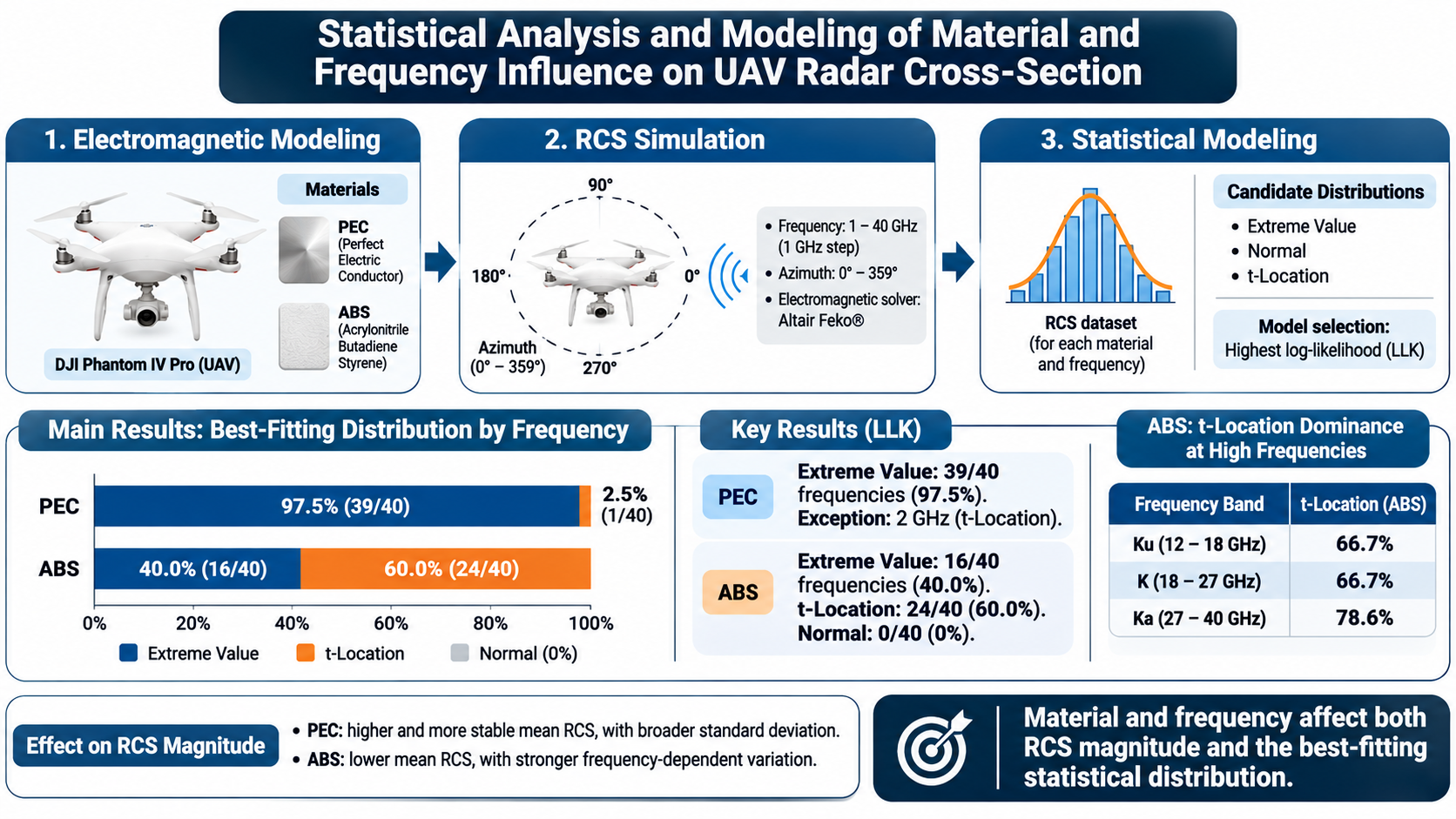
This paper provides the statistical analysis and modeling of the radar cross-section (RCS) for an unmanned aerial vehicle (UAV), the DJI Phantom IV Pro, at typical radar frequencies. Using Feko® software, RCS datasets were generated for incident wave frequencies from 1 to 40 GHz and azimuth angles spanning 0◦ to 359◦. In addition, two materials for the UAV body were considered: a perfect electric conductor (PEC) and an acrylonitrile butadiene styrene (ABS) plastic. Extreme Value, Normal, and t-Location probability distributions were assessed to model the RCS datasets and compared using log-likelihood (LLK) scores. Numerical results show that, among the candidate models considered, the Extreme Value distribution provides the highest LLK for PEC at most frequencies, whereas for the ABS model the highest-LLK distribution alternates between Extreme Value and t-Location depending on frequency. These findings highlight the impact of the electromagnetic material assumption on the RCS statistics and underscore the importance of material- and frequency-dependent statistical characterization for UAV radar applications.
Downloads
Downloads
Published
How to Cite
Issue
Section
License
Copyright (c) 2026 Tiago Ogioni Costalonga, Victor Fernandes, Vanessa P. R. Magri (Author)

This work is licensed under a Creative Commons Attribution-NonCommercial 4.0 International License.
Authors who publish in this journal agree to the following terms:
- Authors retain copyright and grant the journal right of first publication with the work simultaneously licensed under a CC BY-NC 4.0 (Attribution-NonCommercial 4.0 International) that allows others to share the work with an acknowledgment of the work's authorship and initial publication in this journal.
- Authors can enter into separate, additional contractual arrangements for the non-exclusive distribution of the journal's published version of the work (e.g., post it to an institutional repository or publish it in a book), with an acknowledgment of its initial publication in this journal.
- Authors are permitted and encouraged to post their work online (e.g., in institutional repositories or on their website) before and during the submission process, as it can lead to productive exchanges, as well as earlier and greater citation of published work (See The Effect of Open Access).
___________
Accepted 2026-11-19
Published 2026-11-25