Partial Update NLMS Algorithms with varying Time-updating Coefficients for Channel Identification and Echo Cancellation

Authors

DOI:

https://doi.org/10.14209/jcis.2026.17

Keywords:

Adaptive Filter, Communications, Partial Update, System Identification

Abstract

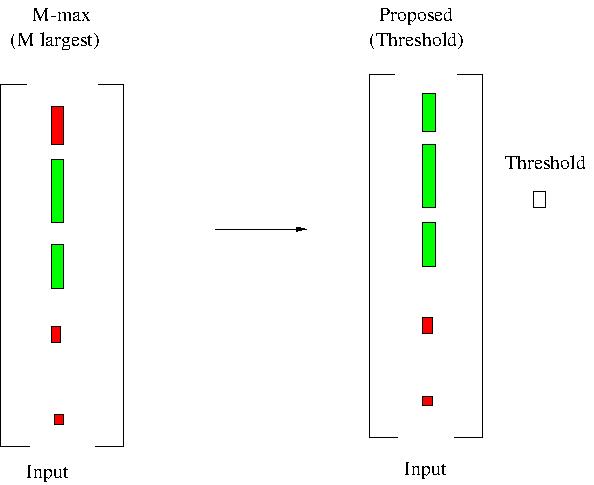
In this paper, partial update adaptive algorithms with a time-varying number of updating coefficients are proposed for channel identification and echo cancellation applications. The proposed algorithms present lower computational complexity than Partial Update NLMS M Maxima and a faster convergence than the Sparse Partial Update algorithm. The proposed algorithms allow a reduction of updates with hardly increasing the mean-square error in comparison to the benchmark algorithms. Sensitivity analysis to the proposed thresholds shows that a reduction of computational complexity may be reached with low MSE degradation.

Downloads
Download data is not yet available.

Author Biographies

Tadeu Ferreira, Universidade Federal Fluminense

UFF- Departamento de Engenharia de Telecomunicações

Markus Vinicius Santos Lima, UFRJ

Markus Lima eceived
the B.Sc. degree in electronics engineering from
the Federal University of Rio de Janeiro (UFRJ),
in 2008, and the M.Sc. and D.Sc. degrees in
electrical engineering from COPPE/UFRJ, in
2009 and 2013, respectively. Currently, he is an
Associate Professor with the Program of Electrical
Engineering (PEE/COPPE) and the Department of
Electrical Engineering (DEE/Poli), UFRJ. He has
co-authored the books Online Learning and Adap-
tive Filters and Block Transceivers: OFDM and Beyond. His research
interests include machine learning theory and applications, adaptive filters,
and digital signal processing. He is a member of the editorial board of
Digital Signal Processing (Elsevier) and IEEE OPEN JOURNAL OF SIGNAL
PROCESSING. He received the Best Paper Award at Brazilian Conference in
Computational Intelligence (CBIC 2023). He has integrated the technical
program committee (TPC) of several conferences and the board of the IEEE
Section in Rio de Janeiro, from 2016 to 2017. Currently, he is the Chair of
the IEEE Signal Processing Chapter in Rio de Janeiro.

Marcello Luiz Rodrigues de Campos, UFRJ

Marcello de Campos eceived the Engineering (cum laude) degree from
the Federal University of Rio de Janeiro (UFRJ),
Rio de Janeiro, Brazil, in 1990, the M.Sc. degree in
electrical engineering from COPPE/UFRJ, in 1991,
and the Ph.D. degree in electrical engineering from
the University of Victoria, Victoria, BC, Canada, in
1995. Since 1998, he has been a Professor with Elec-
trical Engineering Program, COPPE/UFRJ, having
served as Vice-Chair and Chair in 2004 and 2005,
respectively. He is currently a four-year term as Vice-
Director for COPPE. His research interests include adaptive signal processing
in general and its application to distributed networks, in particular, adaptive
beamforming, statistical signal processing, signal processing for communica-
tions, underwater, mobile and wireless communications, and MIMO systems.
He was the IEEE Communications Society Regional Director for Latin America
in 2000 and 2001, Local-Arrangements Co-Chair for GLOBECOM99, Finance
Chair for SPAWC 2008, Plenary Chair for ISCAS 2011, and Technical Co-Chair
for the 2013 Brazilian Telecommunications Symposium. He founded and was
Chair of the IEEE Signal Processing Society Rio de Janeiro Chapter from 2011
to 2017. He is the current Chair of the Visibility & Outreach Committee of the
Signal Processing Society Education Board.

Paulo Sergio Ramirez Diniz, UFRJ

Paulo Diniz was born in Ni-
teri, Brazil. He received the Electronics Engineering
degree (cum laude) in electrical engineering from the
Federal University of Rio de Janeiro (UFRJ), Rio de
Janeiro, Brazil, in 1978, the M.Sc. degree in electrical
engineering from COPPE/UFRJ, Rio de Janeiro, in
1981, and the Ph.D. degree in electrical engineering
from Concordia University, Montreal, QC, Canada,
in 1984. He is currently with the Program of Elec-
trical Engineering and also with the Department of
Electronics and Computer Engineering, COPPE/Poli,
Universidade Federal do Rio de Janeiro. He has authored or coauthored refereed
papers in journals and conference papers in some of these areas and authored
the following textbooks, e.g., Online Learning and Adaptive Filters (Cambridge,
U.K.: Cambridge University Press, 2021, with M. L. Campos, W. A. Martins, M.
V.S. Lima, and J. A. Apolinrio Jr.), Adaptive Filtering: Algorithms and Practical
Implementation (NY: Springer, Fifth Edition, 2020), and Digital Signal Pro-
cessing: System Analysis and Design (Cambridge, U.K.: Cambridge University
Press, Second Edition, 2010, with E. A. B. da Silva and S. L. Netto), and the
monograph Block Transceivers: OFDM and Beyond (NY: Springer, 2012, with
W. A. Martins and M. V.S. Lima). His research interests include analog and
digital signal processing, adaptive signal processing, digital communications,
wireless communications, multirate systems, stochastic processes, and machine
learning. Dr. Diniz was the recipient of the 2014 Charles Desoer Technical
Achievement Award of the IEEE Circuits and Systems Society and some
Best Paper awards from the conferences and an IEEE journals. From 1996 to
1999, he was an Associate Editor for IEEE T RANSACTIONS ON C IRCUITS AND
SYSTEMS— II: ANALOG AND DIGITAL SIGNAL PROCESSING , Circuits, Systems,
and Signal Processing journal from 1998 to 2002, and IEEE T RANSACTIONS
ON SIGNAL PROCESSING from 1999 to 2002. From 2000 to 2001, he was a
Distinguished Lecturer of the IEEE Circuits and Systems Society. In 2004, he
was a Distinguished Lecturer of the IEEE Signal Processing Society. He is also
a fellow of EURASIP. He is a member of the National Academy of Engineering
and the Brazilian Academy of Science

Downloads

Published

2026-10-19

How to Cite

Ferreira, T., Santos Lima, M. V., Rodrigues de Campos, M. L., & Ramirez Diniz, P. S. (2026). Partial Update NLMS Algorithms with varying Time-updating Coefficients for Channel Identification and Echo Cancellation. Journal of Communication and Information Systems, 41(1), 176–186. https://doi.org/10.14209/jcis.2026.17

Issue

Section

Regular Papers
Received 2026-01-30
Accepted 2026-10-12
Published 2026-10-19