Vertical Assessment of RF-EMF Exposure in a Building Adjacent to a Multi-Operator Shared Base Station
DOI:
https://doi.org/10.14209/jcis.2026.8Keywords:
Radiofrequency Electromagnetic Fields, Vertical Assessment, Buildings, Base Stations, Mobile NetworksAbstract
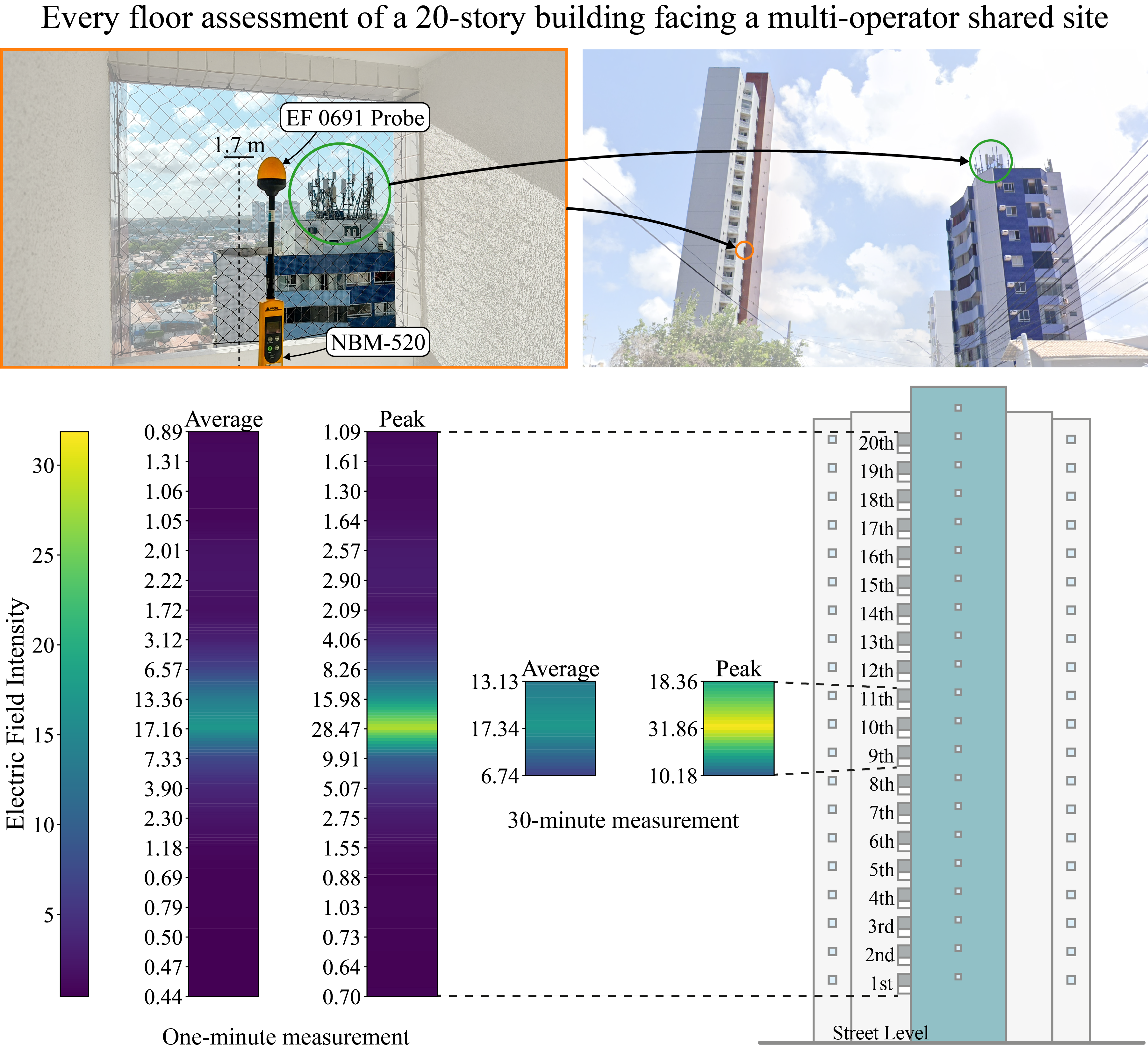
This paper extends a previously published proposed approach for estimating worst-case exposure scenarios in buildings using publicly available Base Station (BS) parameters, applying it to a critical case involving a multi-operator shared site. Radiofrequency Electromagnetic Fields (RF-EMF) exposure was assessed on every floor of a 20-story building facing the site, revealing significantly higher levels near the center of the antennas’ estimated vertical zone of interest, with a peak of 31.86 V/m, 23.95 times higher than the street-level peak value. However, due to uncertainties in the input parameters, measurements across all locations within the zone of interest are required to accurately identify the floor of maximum exposure. The results demonstrate the usefulness of the proposed estimation approach and highlight the need for improved methods that consider BS antenna configurations and current technical information to ensure accurate assessments of exposure to RF-EMF.
Downloads
Downloads
Published
How to Cite
Issue
Section
License
Copyright (c) 2026 Ricardo Queiroz de Farias Henrique Silva, Marcio Eduardo da Costa Rodrigues, Fred Sizenando Rossiter Pinheiro, Gutembergue Soares da Silva, Halysson Barbosa Mendonca, Vicente Angelo de Sousa Jr. (Author)

This work is licensed under a Creative Commons Attribution-NonCommercial 4.0 International License.
Authors who publish in this journal agree to the following terms:
- Authors retain copyright and grant the journal right of first publication with the work simultaneously licensed under a CC BY-NC 4.0 (Attribution-NonCommercial 4.0 International) that allows others to share the work with an acknowledgment of the work's authorship and initial publication in this journal.
- Authors can enter into separate, additional contractual arrangements for the non-exclusive distribution of the journal's published version of the work (e.g., post it to an institutional repository or publish it in a book), with an acknowledgment of its initial publication in this journal.
- Authors are permitted and encouraged to post their work online (e.g., in institutional repositories or on their website) before and during the submission process, as it can lead to productive exchanges, as well as earlier and greater citation of published work (See The Effect of Open Access).
___________
Accepted 2026-03-20
Published 2026-03-27