Mapping Telecommunication Gaps through Socioeconomic and Infrastructure Indicators: A Case Study in Brazil
DOI:
https://doi.org/10.14209/jcis.2026.11Keywords:
connectivity metrics, digital divide, Internet access, social factors, BrazilAbstract
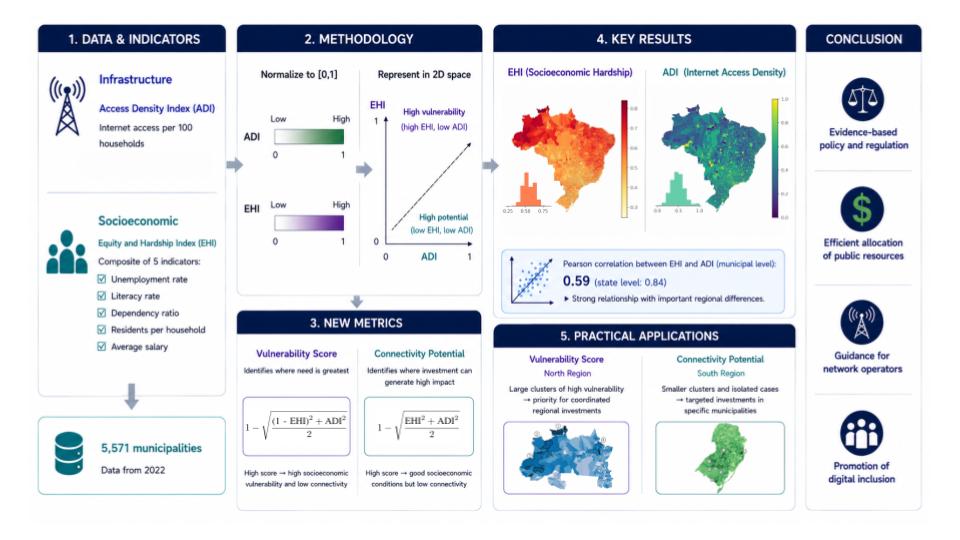
This study addresses the persistent digital divide in Brazil by integrating socioeconomic and infrastructure indicators to identify underserved municipalities with limited Internet access. Building upon the Economic Hardship Index (EHI) and the Access Density Index (ADI), we introduce two novel composite metrics: connectivity potential and vulnerability score. Unlike existing approaches that rely solely on technical or socioeconomic factors, our method captures the intersection of social fragility and infrastructure gaps. Using a vector-based formulation, these metrics reveal both high-potential municipalities, where latent demand for connectivity remains unmet, and critically vulnerable regions where compounded hardship and poor access coexist. Spatial analysis across Brazilian macro-regions, particularly in the North and South, uncovers local disparities that are hidden when only national-level averages are considered. The results highlight the relevance of region-specific strategies and provide a data-driven framework to support policy design, regulatory prioritization, and investment decisions aligned with digital inclusion goals, including those outlined in the IMT-2030 vision for 6G development.
Downloads
Downloads
Published
How to Cite
Issue
Section
License
Copyright (c) 2026 Gabriel Martins dos Santos Cunico, Xisto Lucas Travassos, Richard Demo Souza (Author)

This work is licensed under a Creative Commons Attribution-NonCommercial 4.0 International License.
Authors who publish in this journal agree to the following terms:
- Authors retain copyright and grant the journal right of first publication with the work simultaneously licensed under a CC BY-NC 4.0 (Attribution-NonCommercial 4.0 International) that allows others to share the work with an acknowledgment of the work's authorship and initial publication in this journal.
- Authors can enter into separate, additional contractual arrangements for the non-exclusive distribution of the journal's published version of the work (e.g., post it to an institutional repository or publish it in a book), with an acknowledgment of its initial publication in this journal.
- Authors are permitted and encouraged to post their work online (e.g., in institutional repositories or on their website) before and during the submission process, as it can lead to productive exchanges, as well as earlier and greater citation of published work (See The Effect of Open Access).
___________
Accepted 2026-07-07
Published 2026-07-17