Predicting student progression as a Markov chain
DOI:
https://doi.org/10.14209/jcis.2026.13Keywords:
Markov Chain, Multi-agent SimulationAbstract
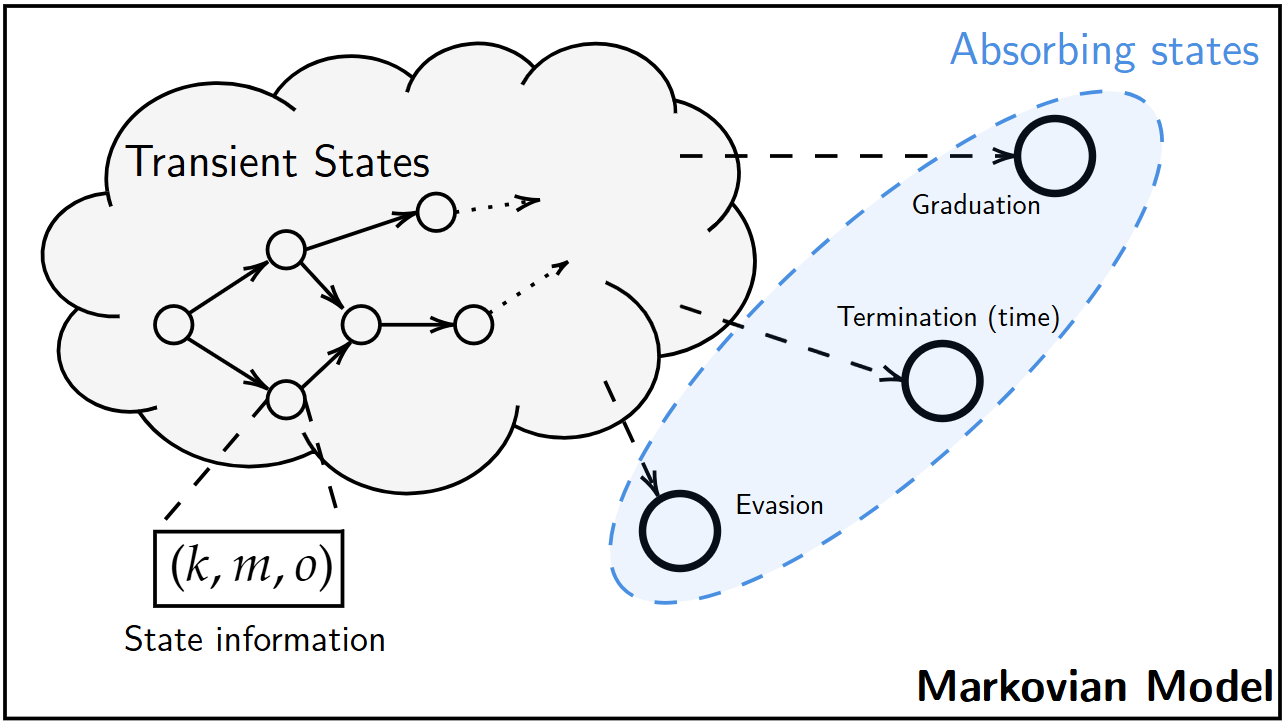
Effective school management may benefit from accurate student progression models to optimize the allocation of instructors and teaching spaces. However, existing research predominantly focuses on Markovian models for year-based programs, leaving a gap in the literature for credit-based undergraduate courses. This paper proposes a framework for modeling the progression of a group of students in credit-based programs using Markov chains, without requiring extensive training. The research addresses three key questions: (1) Can student enrollment and progression be modeled as a Markov chain? (2) Does a multi-agent simulation of a Markov model accurately replicate student-group behavior? (3) Are the multiagent Markov model simulation results akin to real student progression data? To answer these questions, we analyzed student progression data from an engineering program to extract probability distributions for course failure, class enrollment, and dropout rates. These distributions were then used to develop Markov chain models, which were simulated using a multi-agent approach and were compared the real data progression rates. Our findings indicate that a Markov chain model can effectively emulate student progression in engineering programs, and the results from our multi-agent simulation closely match the actual progression data. This framework provides a valuable tool for school management and course demand prediction in credit-based undergraduate programs.
Downloads
Downloads
Published
How to Cite
Issue
Section
License
Copyright (c) 2026 Victor Carneiro Lima, Julia Farias, Renato Lopes, Matheus Souza, Alim Gonçalves (Author)

This work is licensed under a Creative Commons Attribution-NonCommercial 4.0 International License.
Authors who publish in this journal agree to the following terms:
- Authors retain copyright and grant the journal right of first publication with the work simultaneously licensed under a CC BY-NC 4.0 (Attribution-NonCommercial 4.0 International) that allows others to share the work with an acknowledgment of the work's authorship and initial publication in this journal.
- Authors can enter into separate, additional contractual arrangements for the non-exclusive distribution of the journal's published version of the work (e.g., post it to an institutional repository or publish it in a book), with an acknowledgment of its initial publication in this journal.
- Authors are permitted and encouraged to post their work online (e.g., in institutional repositories or on their website) before and during the submission process, as it can lead to productive exchanges, as well as earlier and greater citation of published work (See The Effect of Open Access).
___________
Accepted 2026-07-13
Published 2026-07-27