A Dual-Band Metamaterial Absorber Using Square Loops with Transmission Capability
DOI:
https://doi.org/10.14209/jcis.2026.12Keywords:
Metasurface, absorberAbstract
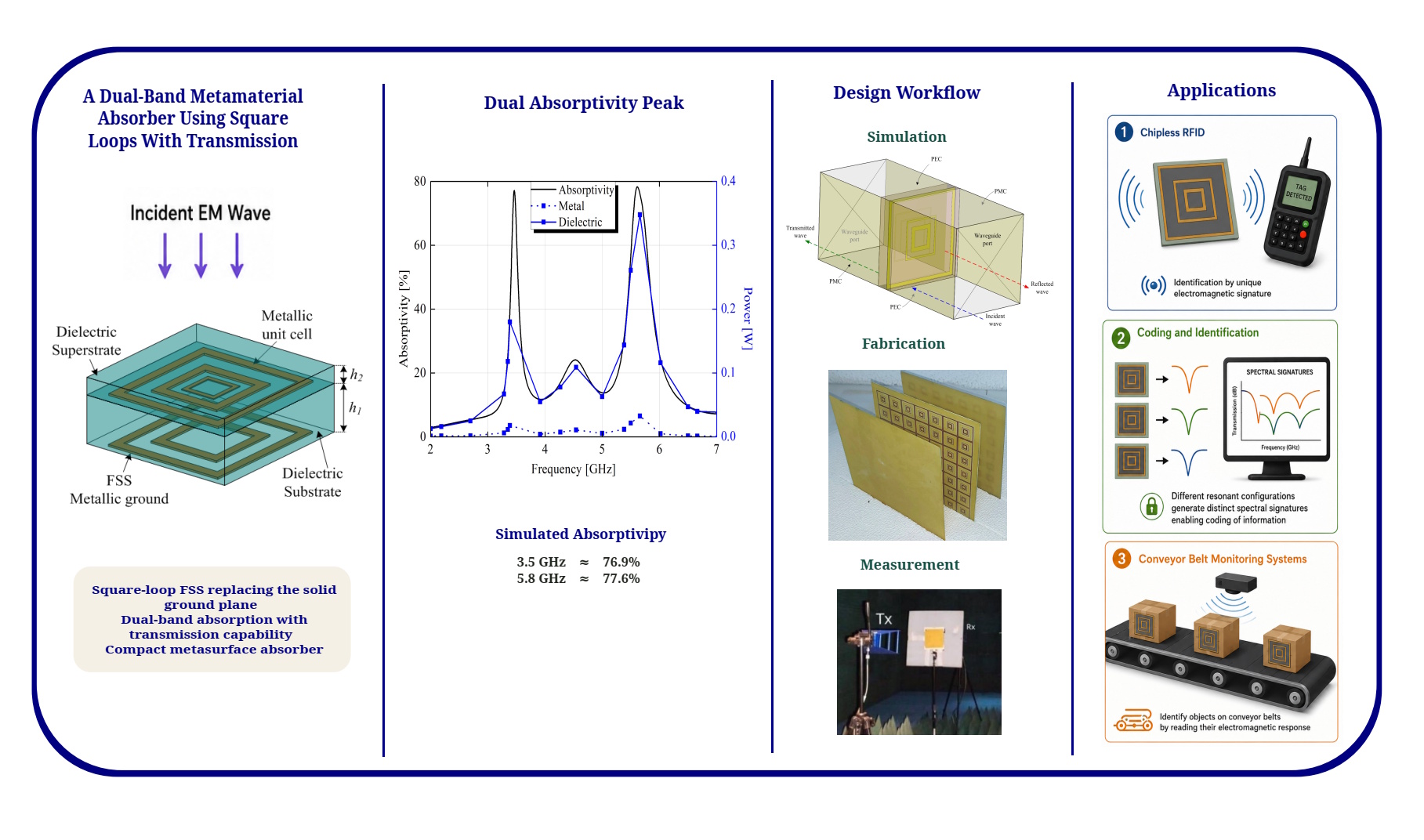
This paper presents the design, fabrication, and characterization of a dual-band metamaterial absorber that utilizes square-loop frequency-selective surfaces on FR-4 substrates. In contrast to traditional absorbers that rely on a solid ground plane, the innovative design features patterned loops in both the ground and front layers, allowing for targeted absorption while still permitting some transmission. Simulations conducted in CST Microwave Studio predicted absorption peaks of 76.9% at 3.47 GHz and 77.6% at 5.63 GHz, with adequate absorption levels of 70.9% at 3.5 GHz and 59.1% at 5.8 GHz. Measurements were performed using a Keysight N5232A vector network analyzer, along with horn antennas, inside an anechoic chamber. This setup confirmed absorption peaks at frequencies close to the desired frequencies, each with magnitudes exceeding 56%, which are sufficient to be used as a chipless identification tag and detect by a reader. The proposed approach highlights the viability of square-loop metasurfaces to achieve compact, tunable, and efficient absorbers with transmission capabilities that are suitable for microwave applications.
Downloads
Downloads
Published
How to Cite
Issue
Section
License
Copyright (c) 2026 Vinicius Barros, Tadeu Ferreira, Maurício Weber Benjó da Silva (Author)

This work is licensed under a Creative Commons Attribution-NonCommercial 4.0 International License.
Authors who publish in this journal agree to the following terms:
- Authors retain copyright and grant the journal right of first publication with the work simultaneously licensed under a CC BY-NC 4.0 (Attribution-NonCommercial 4.0 International) that allows others to share the work with an acknowledgment of the work's authorship and initial publication in this journal.
- Authors can enter into separate, additional contractual arrangements for the non-exclusive distribution of the journal's published version of the work (e.g., post it to an institutional repository or publish it in a book), with an acknowledgment of its initial publication in this journal.
- Authors are permitted and encouraged to post their work online (e.g., in institutional repositories or on their website) before and during the submission process, as it can lead to productive exchanges, as well as earlier and greater citation of published work (See The Effect of Open Access).
___________
Accepted 2026-07-14
Published 2026-07-23