Using 5G URLLC protocol to establish IMS safety zones for industry 4.0: a case study with an autonomous robotic system
DOI:
https://doi.org/10.14209/jcis.2026.10Keywords:
5G URLLC, Industry 4.0, IoTAbstract
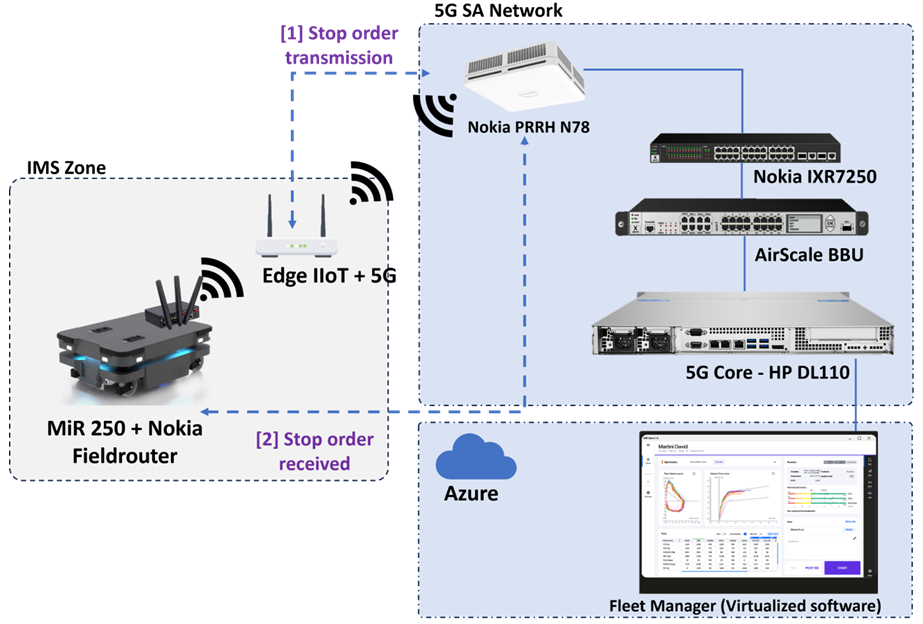
The adoption of wireless technologies in industrial environments has been a highly relevant topic of investigation, considering both the interplay between automation and industrial data communication systems as well as the goal to meet the stringent communication requirements of Industry 4.0, where network reliability and resilience are critical considerations. In such Integrated Manufacturing Systems (IMS), where people and machines interact in an industrial environment, safety aspects also play a fundamental role. In this context, this work investigates a new application framework for 5G URLLC communications in Industry 4.0, taking advantage of the low latency provided by the 5G infrastructure, through the integration of automation safety systems into an IMS architecture. In our setup, an Industrial Internet of Things, IIoT, device uses 5G connectivity to send an emergency stop command to an Industrial Autonomous Mobile
Robot. Our experiment achieved a maximum latency below 1 ms with a block error rate (BLER) below 10-5 on the air interface, including scenarios of high consumption of Physical Resource Blocks (PRBs). The results reinforce the great potential for using 5G networks for worker safety systems and automation elements in industrial environments.
Downloads
Downloads
Published
How to Cite
Issue
Section
License
Copyright (c) 2026 Thiago Silva de Benedito, Murilo Araujo Romero (Author)

This work is licensed under a Creative Commons Attribution-NonCommercial 4.0 International License.
Authors who publish in this journal agree to the following terms:
- Authors retain copyright and grant the journal right of first publication with the work simultaneously licensed under a CC BY-NC 4.0 (Attribution-NonCommercial 4.0 International) that allows others to share the work with an acknowledgment of the work's authorship and initial publication in this journal.
- Authors can enter into separate, additional contractual arrangements for the non-exclusive distribution of the journal's published version of the work (e.g., post it to an institutional repository or publish it in a book), with an acknowledgment of its initial publication in this journal.
- Authors are permitted and encouraged to post their work online (e.g., in institutional repositories or on their website) before and during the submission process, as it can lead to productive exchanges, as well as earlier and greater citation of published work (See The Effect of Open Access).
___________
Accepted 2026-04-14
Published 2026-04-27