An SDR 5G Stand-Alone Multi-Access Edge Computing (MEC) Network to Provide ViNR and VoNR using SIP Kamailio Server
DOI:
https://doi.org/10.14209/jcis.2026.9Keywords:
5G networks, Multi-edge-computing, Software-Defined-Radio, IP-Multimedia-SubsystemAbstract
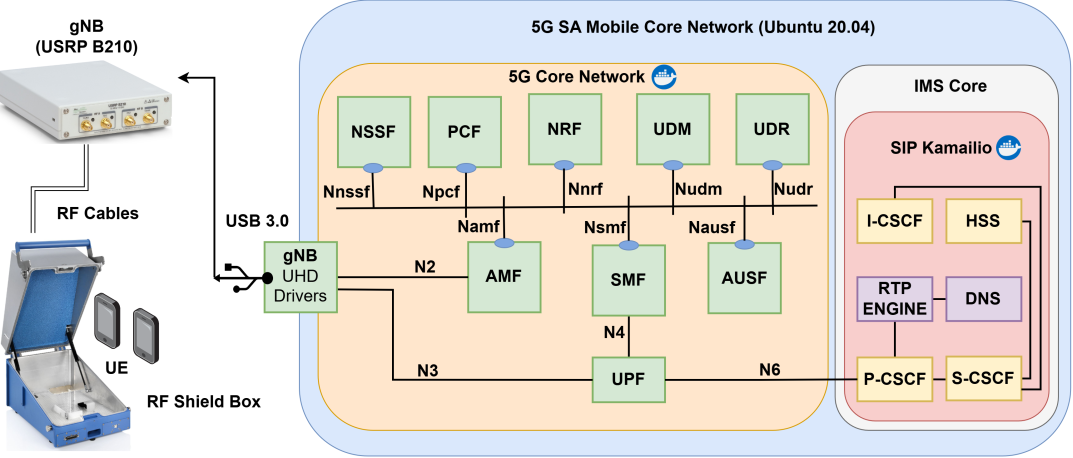
This paper presents a significant contribution to the field of 5G networking through the development and deployment of a Software-Defined Radio (SDR)-based 5G Stand-Alone (SA) network leveraging the Multi-Access Edge Computing (MEC) paradigm. Designed to deliver high-quality voice and video services using the Session Initiation Protocol (SIP) Kamailio Server, our implementation significantly reduces latency by integrating Virtualized Network Functions (VNFs) and Docker containerized elements onto a single workstation, enhancing the efficiency of 5G Core operations. Built entirely on open-source projects, the proposed mobile network successfully provides both Voice-overNew Radio (VoNR) and Video-over-New Radio (ViNR) services using SDR. Notably, this work introduces the first publicly available ViNR prototype for a comprehensive 5G SDR solution, thereby filling a gap in existing research and development. We further detail a complete end-to-end call flow for both VoNR and ViNR, utilizing SIP Kamailio, and provide a valuable resource for researchers and developers. The performance of the proposed network is evaluated through Quality of Service (QoS) metrics, and the computational resource allocation is analyzed. We utilize two smartphones as representatives of typical mobile users to simulate their behavior. The results are then comprehensively compared with those obtained from a high-tech radio communication test station platform, a platform commonly used for certifying terminals, chipsets, and devices against 3GPP standards. Our findings demonstrate that the proposed SDR MEC network exhibits performance closely aligned with that of the robust, established test platform, validating its effectiveness in controlled environments. This research significantly advances the state-of-the-art in 5G SDR MEC networks by providing scalable, efficient, and cost-effective solution for delivering IP multimedia services, with a particular focus on enabling and optimizing Video-over-New Radio (ViNR).
Downloads
Downloads
Published
How to Cite
Issue
Section
License
Copyright (c) 2026 Jussif Abularach Arnez, Walmir Acioli E. Silva, Maria Gabriela Lima Damasceno, Fabrício Falcão de Souza Oliveira, Leandro Almeida Da Silva, Caio Bezerra De Souza (Author)

This work is licensed under a Creative Commons Attribution-NonCommercial 4.0 International License.
Authors who publish in this journal agree to the following terms:
- Authors retain copyright and grant the journal right of first publication with the work simultaneously licensed under a CC BY-NC 4.0 (Attribution-NonCommercial 4.0 International) that allows others to share the work with an acknowledgment of the work's authorship and initial publication in this journal.
- Authors can enter into separate, additional contractual arrangements for the non-exclusive distribution of the journal's published version of the work (e.g., post it to an institutional repository or publish it in a book), with an acknowledgment of its initial publication in this journal.
- Authors are permitted and encouraged to post their work online (e.g., in institutional repositories or on their website) before and during the submission process, as it can lead to productive exchanges, as well as earlier and greater citation of published work (See The Effect of Open Access).
___________
Accepted 2026-03-29
Published 2026-04-02