Quantum Machine Learning for Robust Channel Estimation in Cyclic Prefix-Free OFDM Systems with Impulsive Noise
DOI:
https://doi.org/10.14209/jcis.2026.6Keywords:
Channel estimation, OFDM systems, QML, QSVR, QK-Means, LSAbstract
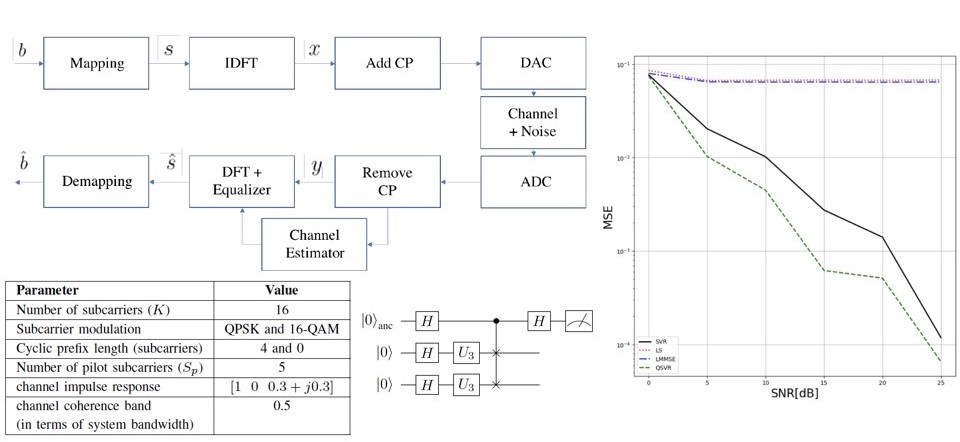
Channel estimation in OFDM systems requires minimal complexity with one-tap equalizers and it is generally performed based on pilot symbols (PS) using least squares (LS). However, in a practical environment where impulsive noise may be present, this method may not be effective; furthermore, the minimal complexity required depends on cyclic prefixes (CP), which must be sufficiently large to cover the channel impulse response. In contrast, the use of PS and CP decreases the useful information that can be conveyed in an OFDM frame, thereby degrading the spectral efficiency of the system. In this context, we propose the use of quantum machine learning algorithms for channel estimation in OFDM systems with a reduced number of PS, without PS, and without CP. Our approach involves adapting classical machine learning models, specifically support vector regression and K-means clustering, to their quantum counterparts by integrating quantum kernels and encoding strategies suitable for channel modeling. The performance of the resulting quantum models is evaluated in comparison to LS and classical learning-based estimators. The viability of our approach is substantiated by computational simulation results obtained in frequency-selective channel models with the presence of non-Gaussian impulsive noise interfering with the symbols.
Downloads
Downloads
Published
How to Cite
Issue
Section
License
Copyright (c) 2026 JOAO DIAS, Caio Silva, Andrias Cordeiro, Demerson Gonçalves, Tharso Fernandes (Author)

This work is licensed under a Creative Commons Attribution-NonCommercial 4.0 International License.
Authors who publish in this journal agree to the following terms:
- Authors retain copyright and grant the journal right of first publication with the work simultaneously licensed under a CC BY-NC 4.0 (Attribution-NonCommercial 4.0 International) that allows others to share the work with an acknowledgment of the work's authorship and initial publication in this journal.
- Authors can enter into separate, additional contractual arrangements for the non-exclusive distribution of the journal's published version of the work (e.g., post it to an institutional repository or publish it in a book), with an acknowledgment of its initial publication in this journal.
- Authors are permitted and encouraged to post their work online (e.g., in institutional repositories or on their website) before and during the submission process, as it can lead to productive exchanges, as well as earlier and greater citation of published work (See The Effect of Open Access).
___________
Accepted 2026-03-09
Published 2026-03-21